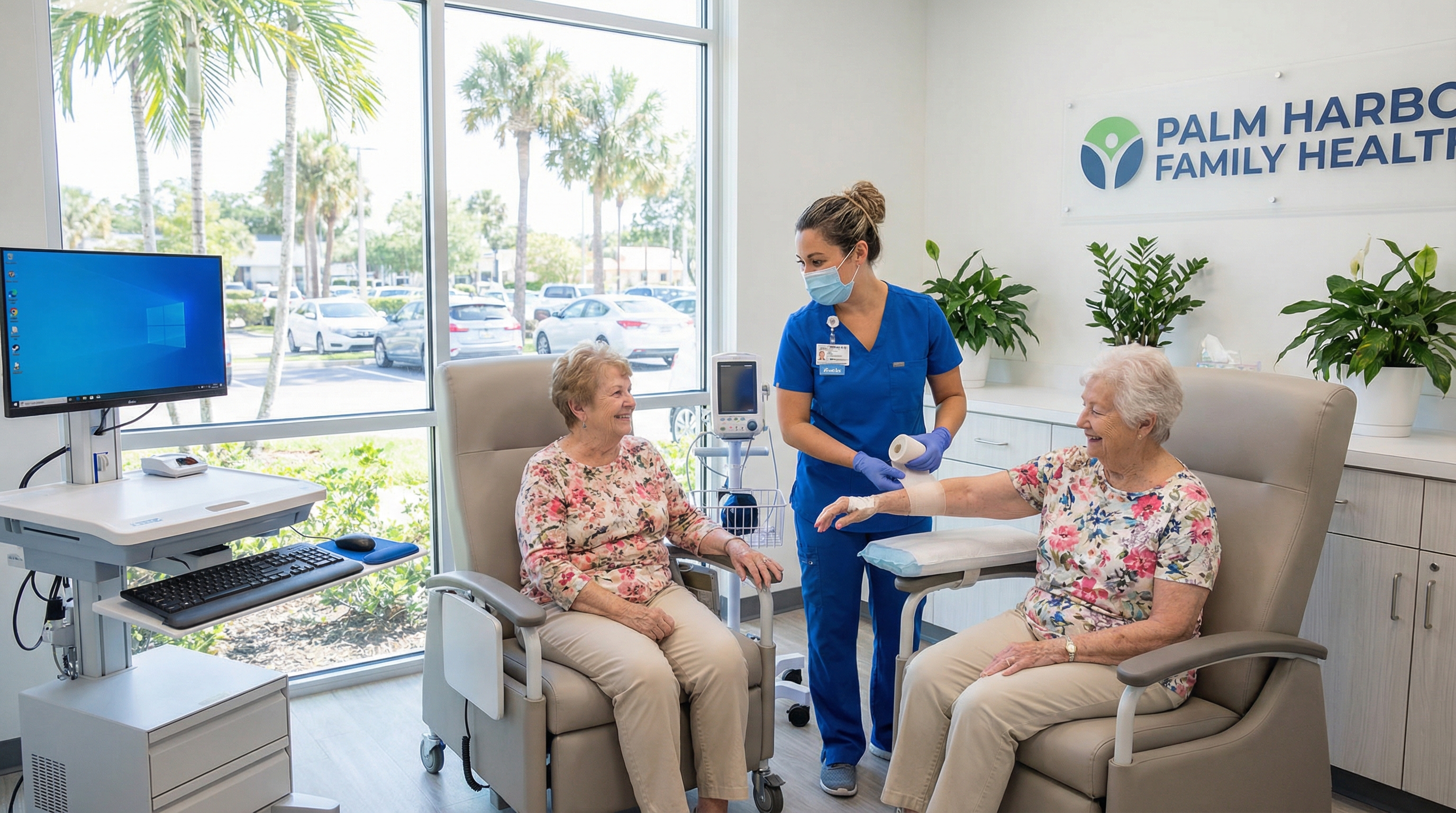
Palm Harbor is home to some of the most successful HMO-contracted medical practices in Pinellas County. But even the most efficient practices often overlook a significant profit leak: wound care referrals. Every chronic wound you send to an external wound center drains money directly from your capitation pool — often $3,000 to $6,000 per patient.
WCHMO specializes in helping Palm Harbor practices across all three zip codes (34683, 34684, and 34685) build profitable in-house wound care programs. The result? You keep your patients, you keep your revenue, and you improve your quality scores.
34683
East Lake area
34684
Central Palm Harbor
34685
West Palm Harbor
Why Palm Harbor Practices Are Uniquely Positioned
Palm Harbor offers several advantages for building an in-house wound care program:
- Strong Medicare Advantage Penetration: Palm Harbor's demographics skew older, with high MA enrollment — exactly the population that benefits most from convenient, local wound care
- Established Practice Infrastructure: Many Palm Harbor practices already have robust nursing staff capable of wound care with proper training
- Capitated Contract Prevalence: The area has significant HMO penetration, meaning wound care efficiency directly impacts profitability
- Patient Convenience Factor: Elderly patients prefer staying with their primary provider rather than traveling to wound centers in Tampa or Clearwater
The Hidden Revenue Drain in Palm Harbor
Let's look at a typical scenario for a Palm Harbor primary care practice with 3,000 patients:
Sample Practice Analysis
- Annual wound patients requiring treatment: 60-75
- Currently referred out: 50-60 patients
- Average cost per wound episode: $4,200
- Annual revenue leakage: $210,000 - $252,000
With proper protocols and training, most practices can bring 70% of these patients in-house. That translates to $147,000 - $176,000 in retained revenue — often enough to fund an additional staff member or significantly boost physician compensation.
What Palm Harbor Practices Can Treat In-House
Not every wound requires a wound center. In fact, the majority don't. Here's what your practice can manage with proper support:
Diabetic Foot Ulcers (Wagner Grade 1-2)
The most common wound type in HMO populations. With proper offloading devices, debridement techniques, and dressing protocols, most diabetic foot ulcers can heal in your office. This also positively impacts your HEDIS measures for diabetic care.
Venous Leg Ulcers
These respond exceptionally well to compression therapy, which can be initiated and managed entirely in primary care. Success rates with proper compression are 70-80% within 6 months.
Pressure Injuries (Stage 1-3)
While Stage 4 pressure ulcers may need surgical intervention, earlier-stage pressure injuries can be managed with turning protocols, specialty mattresses, and appropriate wound dressings.
Surgical Site Complications
Minor dehiscences, infection management, and delayed healing can often be addressed without returning patients to the surgeon.
Minor Burns and Traumatic Wounds
In patients with diabetes or vascular disease, even minor wounds need proper management — but not necessarily specialist care.
WCHMO's Approach for Palm Harbor Practices
We've developed a comprehensive program specifically designed for busy HMO practices:
Phase 1: Assessment (Week 1-2)
- Review your current referral patterns and identify wound types being sent out
- Assess your staff capabilities and training needs
- Analyze your patient population's wound care needs
- Calculate your specific revenue leakage
Phase 2: Protocol Development (Week 2-3)
- Create wound assessment templates tailored to your EHR
- Develop treatment algorithms for common wound types
- Establish clear criteria for when to refer vs. treat in-house
- Set up billing codes and documentation requirements
Phase 3: Staff Training (Week 3-4)
- Hands-on wound assessment and staging training
- Dressing selection and application techniques
- Debridement methods appropriate for primary care
- Photography and documentation best practices
- Patient education strategies
Phase 4: Implementation & Support (Ongoing)
- Supply chain setup with preferred vendors
- Quality metrics tracking and reporting
- Monthly case reviews for complex wounds
- Protocol updates based on outcomes
Real Results from Palm Harbor Area Practices
While we respect client confidentiality, here's what Palm Harbor area practices have achieved with WCHMO consulting:
Primary Care Practice (34684)
- Reduced wound referrals by 68%
- Saved $142,000 in first year
- Improved diabetic care HEDIS scores
- Zero adverse outcomes from in-house treatment
Geriatric Practice (34683)
- Built comprehensive wound care capability from scratch
- Now managing 45+ wound patients in-house annually
- Improved patient satisfaction (no travel to wound centers)
- Added $175,000 to annual retained revenue
Investment and ROI
Our program setup investment typically ranges from $12,000 to $20,000 depending on practice size and complexity. For most Palm Harbor practices, the payback period is 2-4 months.
Consider: if your practice retains just $100,000 in wound care revenue annually after a $15,000 investment, that's a 567% first-year ROI. And the savings compound year after year.
Getting Started in Palm Harbor
Ready to keep your wound care revenue in-house? Here's how to begin:
- Schedule a Free Consultation: We'll discuss your practice situation and goals (30 minutes, no obligation)
- Receive a Custom Analysis: We'll calculate your specific revenue leakage and potential savings
- Review Our Proposal: A detailed plan for your wound care program implementation
- Start Saving: Most practices begin seeing reduced referrals within 30 days of implementation
Palm Harbor Practice Owners
Find out exactly how much you're losing on wound care referrals — and how much you could save.
Calculate Savings Contact UsServing All of Palm Harbor and Beyond
WCHMO provides wound care consulting throughout the Tampa Bay region. In addition to Palm Harbor, we serve:
- Tarpon Springs (34689)
- Clearwater (33755, 33756, 33759, 33761)
- Dunedin & Safety Harbor (34698, 34695)
- Greater Tampa Bay area